
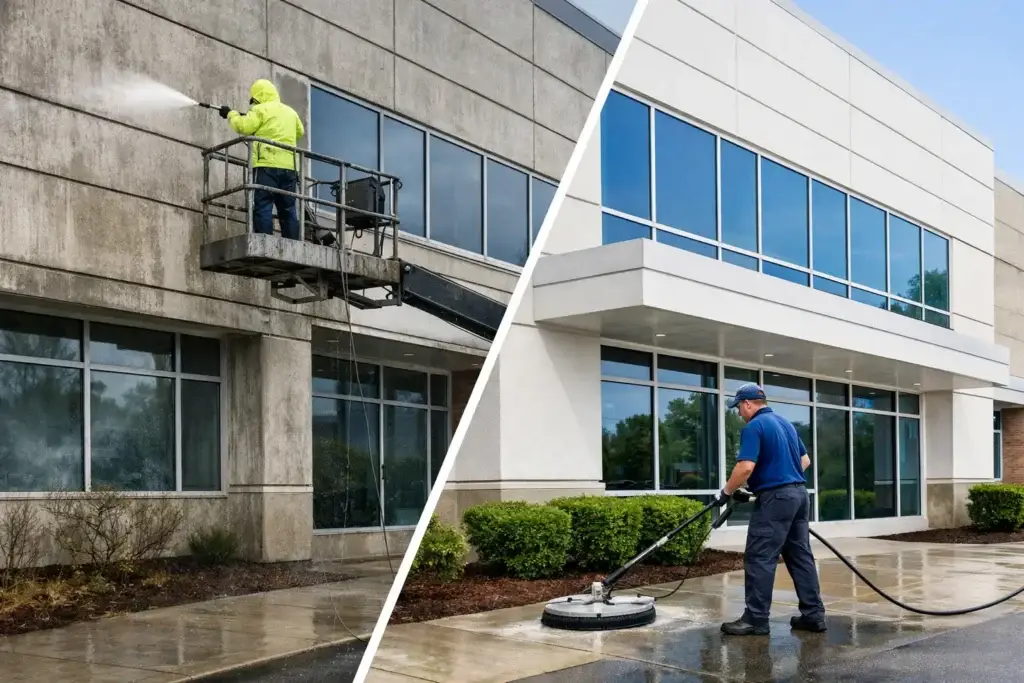
If your building only gets cleaned when someone complains, you do not have a maintenance plan – you have a damage-control plan. The best commercial exterior cleaning schedule keeps your property looking professional year-round, protects surfaces from premature wear, and helps you avoid the bigger costs that show up when grime, algae, mold, and runoff are left alone too long.
For commercial properties, appearance matters, but so does risk. Dirty walkways can become slippery. Overflowing gutters can push water where it should not go. Stained siding, storefront glass, dumpster pads, and entry areas can make a well-run business look neglected. A smart cleaning schedule fixes that before it turns into a tenant complaint, a customer impression problem, or a maintenance bill.
What the best commercial exterior cleaning schedule actually looks like
There is no single calendar that fits every property. A medical office, a shopping plaza, a restaurant, and a warehouse do not collect dirt the same way or at the same speed. The best commercial exterior cleaning schedule is based on traffic, tree coverage, moisture exposure, building materials, and how visible each surface is to customers and tenants.
That said, most commercial properties do well with a layered schedule instead of one annual cleaning. High-visibility and high-use areas usually need attention monthly or quarterly, while larger envelope cleaning can often be done once or twice a year. This approach keeps the property consistently clean without paying for full-service cleaning more often than necessary.
For many Connecticut-area properties, spring and fall are the anchor points. Spring cleaning removes winter residue, salt splash, algae growth, and the grime that builds up after a long wet season. Fall service clears leaves, checks gutters, and gets the property ready before freezing temperatures make existing buildup harder on surfaces.
A practical cleaning schedule by service type
Monthly or as needed
Storefront glass, front entry concrete, dumpster pads, breezeways, and other high-traffic areas often need the most frequent service. If customers walk through the space every day, dirt becomes visible fast. Restaurants, medical offices, retail centers, gas stations, and apartment common areas usually benefit from monthly touch-ups.
This is also the right range for spot treatment of gum, grease, spills, and slippery organic buildup. Waiting too long on these areas rarely saves money. It usually means deeper stains, more labor, and a worse appearance in between visits.
Quarterly
Quarterly service works well for sidewalks, curbs, loading zones, parking entry areas, and lower building sections that catch splashback and grime. Properties near trees, busy roads, or damp shaded areas often need this cadence to stay ahead of mildew and staining.
Quarterly cleaning is a strong middle ground for managers who want the property to stay sharp without overcommitting to monthly full-site work. It is often the most cost-effective interval for mixed-use commercial buildings and professional offices.
Twice a year
Most commercial siding, building exteriors, awnings, and gutter systems should be evaluated for cleaning at least twice a year. In many cases, that means one service in spring and one in fall. Soft washing is often the safest choice for delicate materials, painted surfaces, vinyl, stucco, and roofing components because it cleans thoroughly without the damage risk that comes from using too much pressure.
Twice-yearly service is especially useful for properties in humid coastal or wooded parts of southeastern Connecticut and nearby Rhode Island, where algae and mildew can return quickly. If the property holds moisture or gets limited sun, annual cleaning is often not enough.
Annually
A full building wash, detailed facade cleaning, and broader site refresh can be scheduled annually for lower-exposure properties. This works best for buildings with limited foot traffic, newer surfaces, and good drainage. Even then, annual service should be paired with periodic inspections so problems are caught early.
Annual-only plans can look cheaper at first, but they are not always the best value. If buildup becomes heavy, cleaning takes longer, stains set deeper, and surfaces may not come back as evenly as they would with routine care.
How property type changes the schedule
Office buildings
Professional offices usually need clean glass, tidy entries, and low-stain sidewalks more than constant full-site washing. A practical plan is monthly or bi-monthly entry and window maintenance, quarterly walkway cleaning, and a full exterior wash once or twice a year.
Retail centers
Retail properties need more frequent cleaning because customers notice everything. Sidewalks, curbs, storefronts, and trash areas should be checked often. Monthly service is common for visible public-facing sections, with quarterly concrete cleaning and semiannual building washing.
Restaurants and food-service properties
These locations need the most aggressive schedule. Grease, spills, odor areas, and dumpster pads build up quickly and can create safety and sanitation concerns. Monthly service is common, and some sites need more frequent attention depending on traffic and operations.
Multi-family and HOA properties
Apartments, condo associations, and mixed-use communities need a balance between appearance and budget control. Common walkways, breezeways, pool decks, and entrances usually benefit from quarterly cleaning, while siding, gutters, and roofs are often handled seasonally.
Industrial and warehouse properties
These properties are less focused on curb appeal than retail, but exterior maintenance still matters. Truck bays, loading areas, concrete surfaces, and drainage zones can collect oil, dirt, and runoff. Quarterly or semiannual service is common, depending on use.
Why climate and environment matter more than most owners expect
A building under pine trees will not follow the same schedule as one in an open lot. A shaded north-facing wall can stay damp long enough to grow algae even when the rest of the building looks fine. Coastal moisture, pollen season, winter salt, and leaf debris all affect how often a property needs service.
That is why the best commercial exterior cleaning schedule should be built around local conditions, not a generic national checklist. In Connecticut, spring pollen, humid summers, storm runoff, and fall leaves all create distinct cleaning needs. If your property has gutters, roof lines, siding, or concrete that regularly stays wet, more frequent maintenance is usually the safer choice.
The trade-off between cleaning too often and not often enough
There is a point where more cleaning does not create more value. A lightly used office park may not need monthly pressure washing on every surface. Overservicing can waste budget that would be better spent on targeted maintenance.
But under-servicing is usually the bigger problem. When surfaces stay dirty for too long, organic growth gets established, stains become harder to remove, and small issues stay hidden. The result is often more expensive cleanings, more visible wear, and a property that never quite looks under control.
The right answer is not the cheapest schedule or the most aggressive one. It is the one that matches how the property actually performs through the year.
Signs your current cleaning schedule is not working
If you are seeing recurring green or black streaks, slippery sidewalks, overflow marks from gutters, stained entries, or customer-facing areas that look dirty again within weeks, your schedule is too light or too broad. Another common issue is treating the whole site the same way. High-traffic areas may need monthly service while back elevations only need seasonal cleaning.
A good maintenance plan should make the property easier to manage, not create repeated problem spots. If you are constantly approving one-off cleanups, it usually means the routine schedule needs to be adjusted.
Building a schedule that fits your budget
Start with visibility and risk. Entryways, storefronts, public walkways, dumpster areas, and any surface that gets slippery should be the first priority. Then look at surfaces that are expensive to replace or easy to damage when neglected, such as roofing, siding, painted trim, and gutters.
From there, split your plan into recurring touch-up service and seasonal deep cleaning. That gives you cleaner results throughout the year without paying for complete site washing every month. It also makes scheduling easier for tenants, staff, and operations.
For many businesses, the most efficient setup is monthly or quarterly maintenance for public-facing problem areas, plus semiannual soft washing for the building exterior. That pattern gives you a clean property, fewer surprises, and better control over long-term maintenance costs.
If you want the schedule to work, the cleaning method matters too. High pressure is not the answer for every surface. Safe soft washing and professional-grade equipment can remove buildup effectively while protecting siding, roofing, trim, and other vulnerable materials. That is a big part of why commercial owners choose experienced crews instead of handing the job to a general maintenance vendor.
A clean building sends a simple message before anyone walks through the door: this property is cared for, professionally managed, and worth taking seriously. The best schedule is the one that keeps that standard in place without overcomplicating the process. If your property has been running on occasional cleanups, now is a good time to move to a plan that actually stays ahead of the mess.