
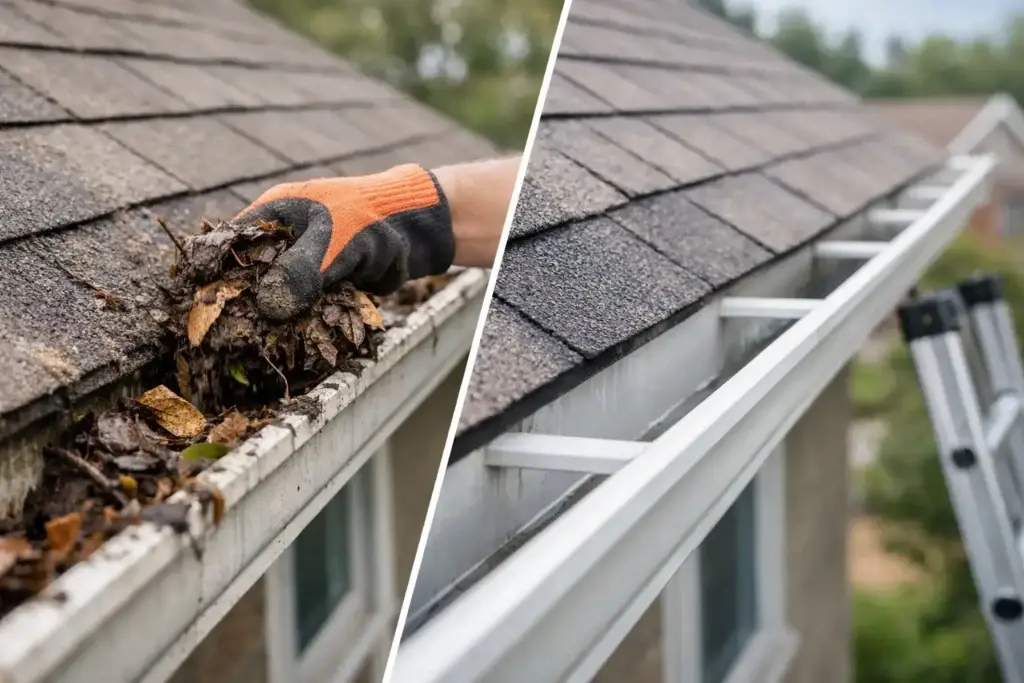
A gutter problem usually does not announce itself with much drama. It starts with a small overflow during a rainstorm, a strip of dirty water down the siding, or a flower bed that keeps washing out no matter how many times you fix it. That is why gutter cleaning tends to get pushed down the list until a minor clog turns into a bigger repair.
For most homeowners, the real issue is not just appearance. Clogged gutters can send water where it should never go – behind fascia boards, around foundations, onto walkways, and into landscaping. A simple maintenance service can help prevent wood rot, ice issues in colder months, and the kind of moisture problems that get expensive fast.
Why gutter cleaning matters
Your gutter system has one job: move rainwater away from your home efficiently. When leaves, pine needles, roof grit, and debris build up, that system starts failing in predictable ways. Water spills over the edge instead of flowing through the downspouts. In some cases, it backs up under the roofline or sits in the trough long enough to add unnecessary weight.
That standing water is where a lot of damage begins. Gutters can pull away from the house, fasteners can loosen, and wood trim can stay wet longer than it should. Even if the overflow seems minor, repeated saturation around the home can lead to foundation settling, basement moisture, and erosion around entryways.
In Connecticut and nearby coastal areas, the weather makes this more than a once-a-year concern. Spring pollen and seed drop, summer storms, fall leaves, and winter freeze-thaw cycles all contribute to buildup and drainage problems. Homes with mature trees often need more attention than homeowners expect.
Signs your gutters need cleaning
Some signs are obvious, and some only show up when it rains. If you notice water pouring over the sides, sagging sections, plant growth in the gutters, or downspouts that barely drain, the system is already clogged enough to affect performance.
You may also see subtler warning signs. Dark streaks on siding, muddy splashback around the foundation, peeling paint near the roofline, or recurring puddles near the house can all point to a gutter issue. In colder weather, icicles and ice buildup along the edge of the roof can also suggest poor drainage.
It depends a bit on the property. A house surrounded by pines will collect debris differently than an open lot with very few trees. Steeper rooflines may move debris faster into the gutters, while certain valleys and roof transitions tend to concentrate it in specific sections.
How often should gutter cleaning be done?
For many homes, twice a year is a good baseline – once in the spring and once in the fall. That schedule works well when the home has moderate tree coverage and no ongoing drainage issues.
But twice a year is not a rule for every property. If your home sits under heavy tree canopy, especially oak, maple, or pine, you may need service more often. Pine needles are especially problematic because they compact tightly and can clog downspouts even when the gutter itself does not look completely full.
Storm activity matters too. One bad weather event can fill sections with branches, seed pods, and roofing grit. If you have had strong winds or heavy rain, it is smart to check the system before the next storm tests it again.
For commercial properties, frequency often comes down to visibility, liability, and drainage load. Overflow near entrances, sidewalks, or storefronts creates a different level of urgency than a less visible issue on a residential back elevation.
What happens when gutter cleaning gets delayed
Most homeowners delay gutter service for the same reason they delay other exterior maintenance – if nothing looks broken, it feels safe to wait. The trouble is that water damage rarely stays visible in one neat spot.
Overflow can stain siding and trim. Backed-up water can soften wood around fascia and soffits. In some homes, clogged gutters contribute to roof edge problems because water lingers where it should drain quickly. Once that moisture gets into vulnerable materials, repairs are no longer simple maintenance.
There is also the drainage issue below. Water that should be directed away from the home can instead collect near the foundation. Over time, that can create settling, cracking, or damp basement conditions. Even if the gutter itself is inexpensive to maintain, the damage caused by neglect usually is not.
DIY gutter cleaning vs hiring a professional
Homeowners often ask whether this is worth doing themselves. The honest answer is that it depends on the house, the height, the roofline, and your comfort level on a ladder.
A single-story home with easy access is very different from a two-story house with steep sections, tight corners, and heavily packed debris. The cleaning itself is only part of the job. Safe ladder setup, proper debris removal, downspout flushing, and spotting signs of damage all matter.
Professional gutter cleaning is usually less about convenience alone and more about reducing risk while getting a more complete result. A trained crew can identify loose brackets, drainage problems, improper pitch, and trouble spots that a quick scoop-out might miss. That is especially valuable if you have had recurring overflow and are not sure why.
For many property owners, the real benefit is consistency. The job gets done thoroughly, on schedule, and without turning a Saturday into a ladder project.
What a professional gutter cleaning service should include
Not all services are equally thorough. At a minimum, the gutters should be cleared of debris and the downspouts should be checked to confirm they are draining properly. If the downspouts stay clogged, the problem is only half solved.
A good service should also involve a visual check of the system. That includes looking for sagging sections, separated joints, loose fasteners, and signs of overflow damage. In some cases, the gutters are not just dirty – they are misaligned or partially detached, which changes the next step.
Cleanup matters too. Debris should not be left scattered across walkways, garden beds, or driveways. The goal is a clean, functioning system and a property that looks better when the job is done.
Gutter cleaning and curb appeal
Most people think of gutters as a preventive maintenance item, and they are. But they also affect how the property looks. Overflow creates staining on siding, algae streaks near trim, and dirty runoff marks that drag down the whole exterior.
If you are already investing in house washing, roof cleaning, or window cleaning, neglected gutters can stand out even more. Exterior maintenance works best when it is approached as a system. Clean surfaces, proper drainage, and well-kept trim all support the same goal: protecting the property while keeping it looking cared for.
That is one reason homeowners across southeastern Connecticut often bundle gutter cleaning with other exterior services. It saves time, keeps maintenance more organized, and helps prevent one issue from undermining the rest of the work.
When to schedule service
If your gutters overflow in rain, do not wait for the next season. Schedule service as soon as possible. The same goes for visible plant growth, sagging runs, or downspouts that are clearly blocked.
If there are no obvious problems, the best timing is usually before peak fall leaf drop and again after winter debris has had a chance to settle. Homes near large trees may benefit from an extra mid-season check. There is no perfect universal calendar, but there is a clear pattern: gutters work best when they are maintained before they fail, not after.
For property owners who want fewer surprises, recurring service makes the most sense. It removes the guesswork and reduces the chance that a drainage issue goes unnoticed until it becomes more serious.
CT Softwash LLC works with homeowners and property managers who want that kind of straightforward maintenance – fast scheduling, professional service, and clear results without the hassle.
A clean gutter system is not flashy, but it protects some of the most expensive parts of your property. If you have been putting it off, this is one of those jobs that pays off most when you handle it before the next hard rain.